Showing posts with label writing. Show all posts

Wednesday, December 11, 2013

No no, NaNoWriMo


In November, I announced that I would attempt two writing goals at the same time: NaNoWriMo (National Novel Writing Month) and NaBloPoMo (National Blog Posting Month). As you can tell by looking at last month’s posts, I succeeded at the former. The latter...not so much.

Needless to say, I did not partake of this cake.
Photo credit: cvillewrimos (Flickr)
 
My participation in NaNoWriMo consisted of fitful writing on paper and a few pages in Word.
 
It looked like this.
 
I learned two facts about myself.

One, I cannot achieve two major writing goals in a month. And have a busier-than-average-for-this-year freelance slate. And help take care of our neighbor. And do all the other things I need to do.

Two, the NaNoWriMo format does not work – for me.

The goal of NaNoWriMo is to write a 50,000-word (or more) novel in the thirty days of November. I did some calculations, and this is what it means:

50,000 words divided by thirty days equals (approximately) 1,667 words per day.

A letter-sized (8.5 x 11 inches) page of words in Courier New font, double-spaced (the usual standard for writing submissions) adds up to about 250 words.

1,667 words divided by 250 equals approximately 6.7 pages per day.

Now, I can write 6.7 pages of fiction on any given day.

I am not sure about writing 6.7 pages of fiction every day for a month – on top of all the other things I must do.

But you know what?

That’s OK.

I don’t need NaNoWriMo to write a novel. Most writers don’t.

If you were to average just one page a day for a whole year, you would end up with 365 pages (on non-leap years). 365 times 250 equals 91,250 words – way above the NaNoWriMo minimum of 50,000.

(Did you notice that there’s more math in this post than in the previous 262 combined?)

If I take just half a year, or six months, I’ll just need to write two pages a day.

Hey...I can do that.

If I keep it in mind...and just do it.

Sunday, December 1, 2013

This is not a NaBloPoMo post...

...it's the first of December!

But I just want to show you what I waited for all last week...


...sitting at a coffee shop to read and write.

Wednesday, November 27, 2013

Show, don’t tell – what?

What the hell is this guy talking about?

This writing instruction should be banished as thoroughly as the opening line “It was a dark and stormy night...” It has caused more anxiety and more worry for writers than any other “classic” bit of advice.

First of all, have you read two writing experts who agree on exactly what this means? Do you have any idea what this means? If you opened a page at random from any novel, could you tell (no pun intended) if the writer was “showing” or “telling”?

Secondly -- and most important, so pay attention -- all writing is telling. When you use words, you can do nothing else but tell. Only pictures show. Why is it called “storytelling” and not “storyshowing”?

In other words, this is one more thing you don’t have to worry about anymore.


NaBloPoMo November 2013

Monday, October 14, 2013

Writers, never be ashamed of your subject matter


Photo credit: lucianotb (stock.xchng)
If you write about taboo, difficult, or controversial subjects, you will encounter people who will try to make you feel ashamed of your words:

You have a filthy mind.

Why do your characters have to cuss so much? You have more imagination than that.

Violence is cheap conflict.

That is racist/sexist/homophobic language, and it will cause unnecessary pain.

Statements like these are not about the writer. They are about the critic and his/her personal dislikes, which are as individual and as idiosyncratic as a fingerprint.

You can’t pull back your words because someone, somewhere, will dislike them. Because that is a guarantee, no matter what you write. You can write the mildest “inspirational” (i.e., conservative Christian) romance possible, and someone will still hate it.

Sex is a part of life. So is violence. Anger. Strong language. Bigotry. Thoughts that are not nice, polite, or civilized.

They are all things that happen in life.

Is it wrong to speak about things that happen in life?

We writers must write the scenes and use the words that our story demands. Not edit them based on fear of a real or imaginary critic.

I used to be ashamed of my controversial writing. No more. I have too many words left in me to waste time on shame.

And so do you.

Wednesday, July 10, 2013

It eats your life


Photo credit: asifthebes (stock.xchng)

Not too long ago, I was listening to one of my favorite podcasts, “The Karel Show.” Karel was talking about how one of his radio mentors gave him this advice: start your show with the topic that’s most important to you at this moment – whether or not it’s in the news. 

That makes sense. When the host cares passionately about the subject, it makes for compelling radio.

I am sure the same goes for blogs. I see a recurring theme in another of my favorite podcasts, “Blogcast FM”: write about what’s important to you, even if it’s scary or controversial or emotional (or all of the above).

As you can tell, I missed my post quota for the month of June, and July is nearly one-third over and I still haven’t posted. Why?

I have been living in the real world less than half the time lately. Sometimes it’s like I’m only 10% in reality and 90% in –

Wait.

Let me find the right words.

This is still a public blog. I need, and want, to approach the subject obliquely.

I know my husband does not read this blog. But there’s a first time for everything.

So…

Let’s give this a name: Damn Trouble.

Damn Trouble is in my head, eating up most of the other thoughts that usually reside there. Thoughts of business and new ideas and creativity and beauty and photography and walking and travel and trains and books and authors and podcasts and good food and friends and family.

Damn Trouble is dangerous – I know it is – but it’s sexy and exciting and thrilling and gives me a break from my utterly boring real life.

Damn Trouble compels me to Google it and try to gather as much information about it as possible – and when I find all of the information, I Google again because I just like reading about it, like when I was six and collected multiple “Cinderella” books.

Damn Trouble is a damn problem, that's for sure.

But...

Damn Trouble has one, and ONLY one, upside – it is compelling me to write fiction again. Years ago, it was easy to write fiction – when I had the juice, which flows from a deep and frankly erotic place. Without this juice, my writing is non-fictional and relatively tame.

Now, the wild and crazy ideas are coming – ideas which may very well fit in with the new edgy, sexually explicit novels which are popular these days. Who knows…letting Damn Trouble come out and play in a healthy way could solve more than one problem for us.

That’s the way to beat it.

Monday, March 25, 2013

Putting the (virtual) cart before the horse


Photo credit: chahad (stock.xchng)

It was a fitful weekend, and this Mouse was overdue for a good meander. After dinner plans with a friend got postponed, I decided to take a walk in one of my favorite places, the Floral Park neighborhood in Santa Ana.

It was a great time to walk – in the latter part of the afternoon, when the heat and sunshine that can interfere with a good walk were on their way out.

When I have nothing to do but put one foot in front of the other, it energizes my mind. I thought about which home tours I went on between 2009 and now. I thought about all of the spiders I discovered spinning giant webs between the trees. (If I were a spider, I’d choose Floral Park, too!) And, as oft happens, I thought about my career in writing and graphic arts and what I would do to improve it.

I remembered an article in Writer’s Digest about what today’s writers need to do in order to succeed. The top three suggestions were, I believe:

1. Sell yourself on Facebook.

2. Sell yourself on Twitter.

3. Sell yourself at every frigging opportunity you can think of.

With all of this selling, when will you find time to – ahem – write?

The people and companies that I follow on Facebook and Twitter give me real value. They are (mostly) people I liked before I found them on Facebook and Twitter – people I liked before Facebook and Twitter even existed.

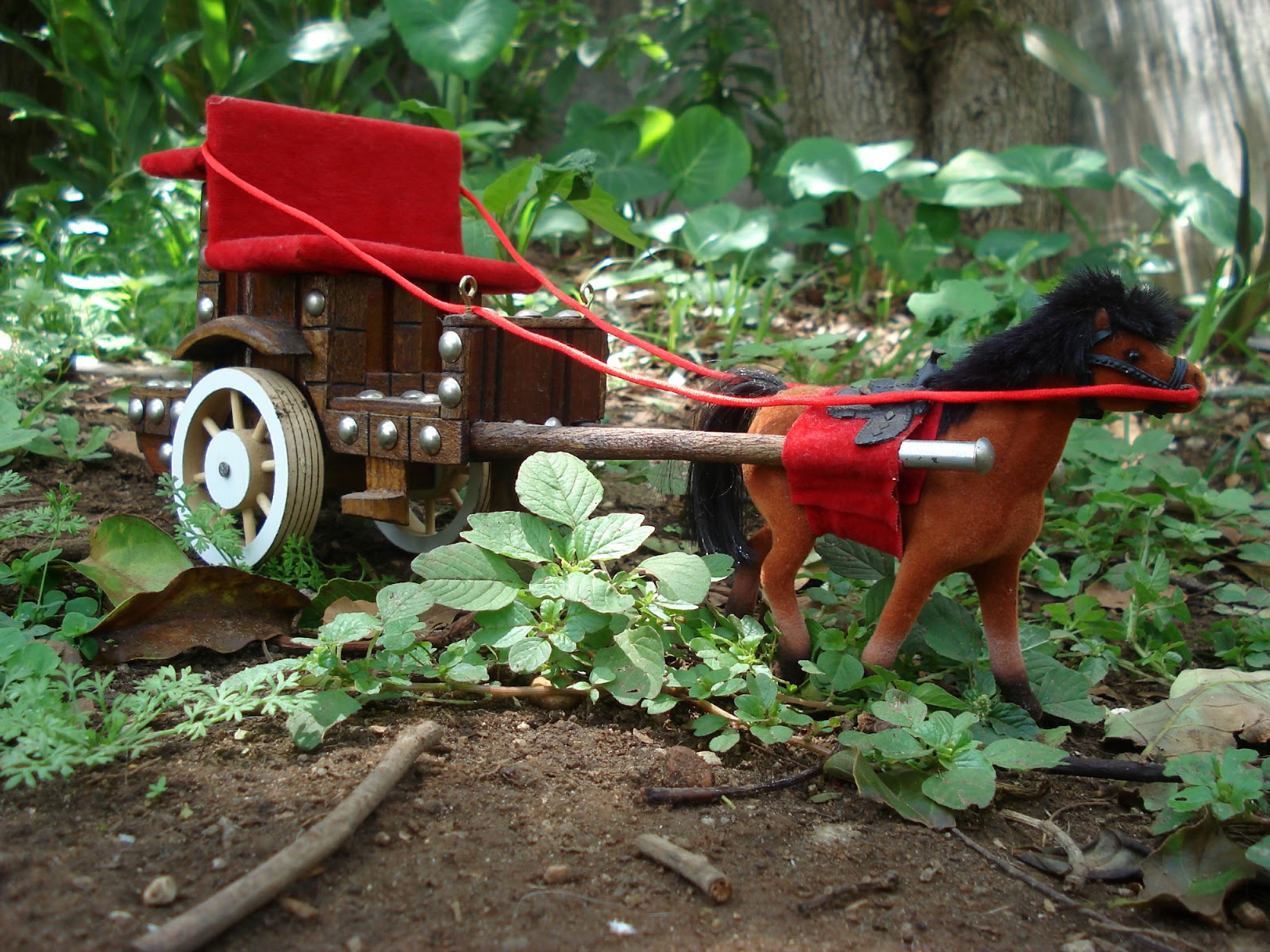
Which gets me to the story of the cart and the horse.

The horse is your core message – who you are, what you have to offer the world, whatever it is that makes you a creature unlike any other.

The cart is your marketing program, whether it be social media or more old-fashioned types of advertisement.

If your horse is weak, it’s not going to pull your cart very far.

If you put so much effort into building your cart that you neglect your horse, you’re going nowhere.

If your message resonates, it will keep your social media cart rolling. You will have many followers because you will have earned them.

People who send out tons of boring, useless Tweets are the first to get unfollowed. People whose Tweets are always informative, entertaining, and/or helpful – whether or not they have anything to do with the business – will hold on to their current followers and add many more.

It’s the content of your content that matters.

In short:

1. You should spend no more than half an hour – if that – on your Twitter and (professional) Facebook accounts per day.

2. Before you post, ask:

     a. Is this relevant to my current and would-be followers?
     b. Would this post make me want to follow myself?
     c. Does this post make my business shine?

3. Feed your horse first, and your cart will go, go, go!